Complimentary Legacy Calibration & Insured Global Shipping on All Masterpiece Orders




The Resonance Pathway

✦ The Daozang Archives · Consecration & Fulfillment Protocol ✦
The Resonance Pathway
The Dual-Track Protocol of Hand-Carving, Purification, and Solar Calibration
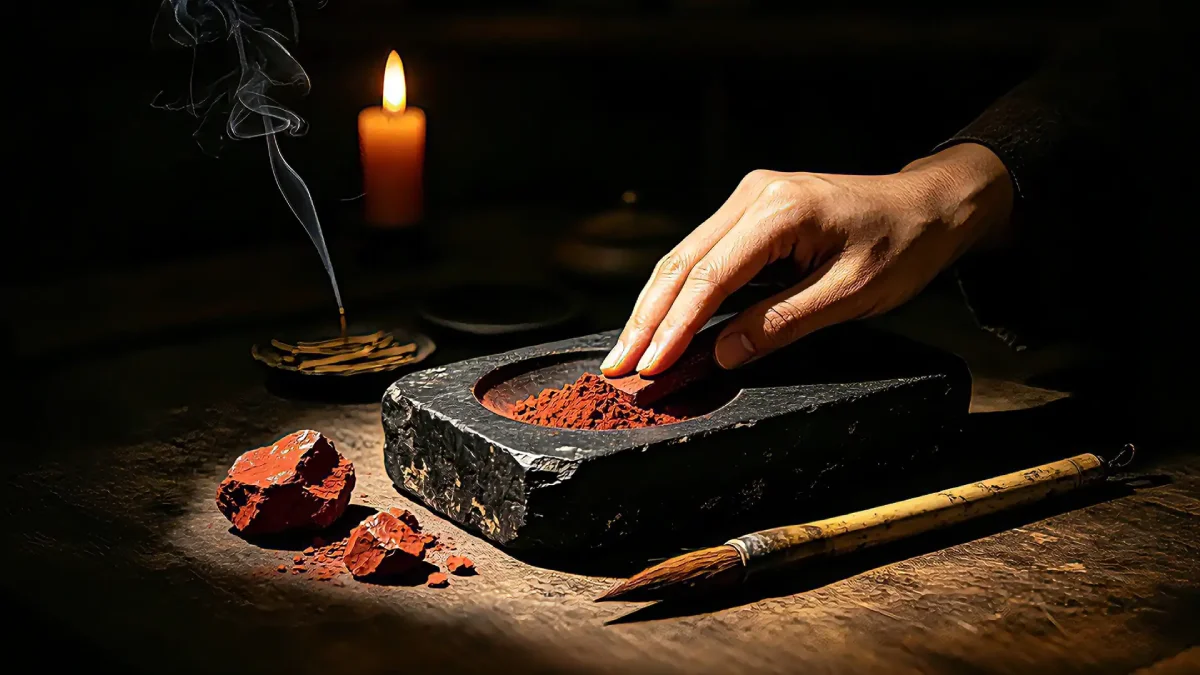
Fig. 1 — The Alchemical Table: Natural cinnabar, ceremonial ink stone, and dedicated intentional attunement.
“An artifact without dedicated calibration remains merely an object of raw timber or stone. Time, hand-carving, and sacred alignment are the vital bridges that elevate matter into an active, chronological presence.”
An artifact without legacy calibration remains, in the most literal sense, an unfulfilled form. In twelve centuries of unbroken Daoist material heritage, a symbolic vessel is never treated as an off-the-shelf commodity. It requires an unhurried, disciplined journey of preparation before it is fit for custody.
At ManoVotTao Heritage, rooted in the Baiyunguan tradition, our creation unfolds across two distinct fulfillment tracks—balancing meticulous hand-sculpting with astronomical solar calibration.
✦ The Dual-Track Fulfillment Timelines
To honor both ready sanctuary collections and individual custom commissions, our monastic workshops operate under two exact preparation pathways:
1. Standard Sanctuary Collection (3-Day Protocol)
Masterworks pre-carved by our lineage masters, requiring strictly 3 business days of dedicated solar calibration and natal coordinate attunement prior to secure international dispatch.
2. Bespoke Private Commissions (7-Day Dual Track)
Sculpted individually from virgin lightning-struck timber upon order placement. Requires 4 days of meticulous hand-carving and dimensional proportioning, followed seamlessly by the 3-day solar consecration cycle (7 business days total prior to dispatch).
✦ The Three-Day Solar Consecration Cycle
Whether standard or bespoke, the final phase of every creation culminates in our mandatory three-day solar calibration. Conducted within our monastic sanctuary, the sequence follows an exacting cosmological logic:
DAY I — PRIMORDIAL PURIFICATION
The carved vessel is secluded from mundane contact within a tranquil, incense-scented chamber. Natural botanical resins clear residual environmental static, restoring the organic timber to absolute primordial clarity.
DAY II — COSMIC SIGIL ATTUNEMENT
The purified piece undergoes intentional cosmological orientation. Masters align the talismanic geometry with twelve centuries of traditional lineage wisdom, establishing a bridge between sacred form and universal order.
DAY III — NATAL ALIGNMENT & CELESTIAL SEALING
The final phase. The artifact is calibrated specifically to your personal birth date and natal polarity. Solar energy seals the energetic matrix, transforming the object into your enduring anchor for focus and serenity.
✦ An Unhurried Covenant with Time
For us, these dedicated preparation windows are never an added flourish—they are an indispensable act of completion. Time is an organic medium of its own; true hand-carving and chronological alignment cannot be hurried. It ensures that when your piece arrives, it possesses both flawless material craftsmanship and genuine spiritual depth.
